
“Tikopia: A Path to Eternity”A 3,000-year experiment in living within limits

In the middle of the South Pacific—far from trade routes and devoid of extraordinary resources—there exists a small island with an outsized lesson for humanity. Its name is Tikopia.
Despite its size, it has been continuously inhabited for nearly 3,000 years.
In a world where many island societies collapsed after exhausting their resources, Tikopia chose a different path: it learned to live within its limits.
A CLOSED SYSTEM
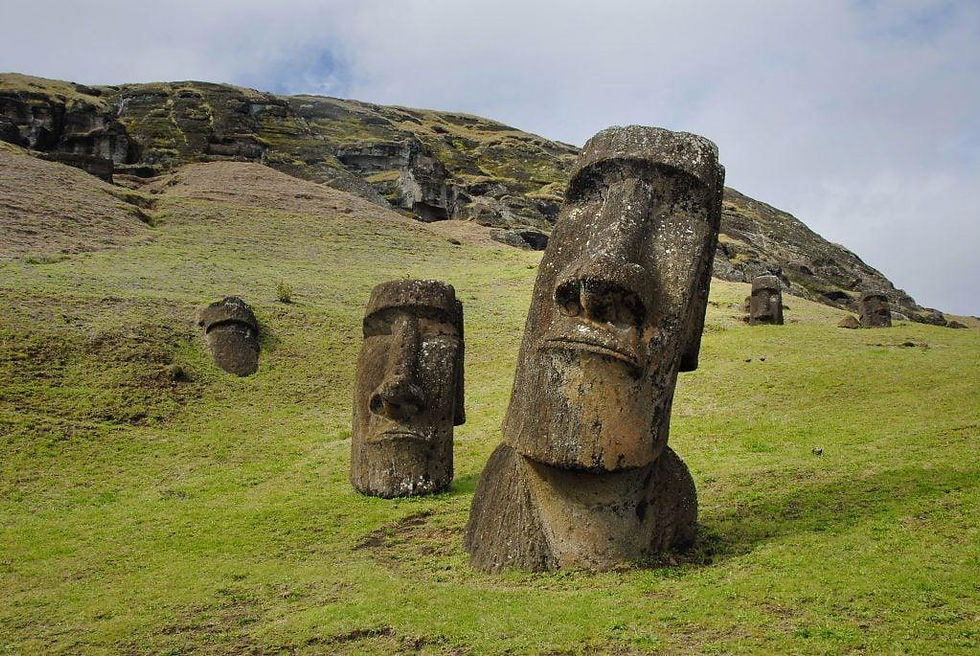
Like Rapa Nui
Tikopia is a closed system.
It has no major rivers, no strategic minerals, and no steady trade to rescue it in times of crisis.
For centuries, its population remained around 1,000–1,200 people—not because it couldn’t grow, but because the society deliberately ensured it didn’t exceed the island’s capacity to sustain life.
This was not an accident. It was design.
Deliberate POPULATION CONTROL
Unlike Rapa Nui, Tikopia developed conscious and sometimes harsh mechanisms to maintain equilibrium between people and resources:
Institutionalized celibacy
Traditional contraception methods
Restricted paternity rights, often limited to the eldest male
The exile of young men to sea, never to return
And, in times of extreme stress, practices such as infanticide
This is not a comfortable history—but it was effective. The population rarely exceeded what the island could sustain.
The roots of AGROECOLOGY
Rather than clearing
forests indiscriminately,
Tikopia reshaped them.
They developed a multi-layered agroforestry system that mimicked a natural forest:
Coconut and fruit trees in the upper canopy
Tubers and root crops in the middle layers
Smaller plants below
They turned the forest into a productive ecosystem without destroying its structure. Soil remained protected. Moisture was retained. Regeneration cycles continued. Biodiversity stayed relatively stable.
They didn’t deplete natural capital. They managed it.
RESILIENCE in the face of disaster
Over 3,000 years
Tikopia endured
powerful cyclones
Yet, thanks to careful resource management, it repeatedly recovered—without losing its cultural foundation.
In 1952, a cyclone devastated nearly all infrastructure and crops. The community rebuilt. The system stabilized again.
They had margin. The system was never pushed beyond its limits.
AUTHORITY with consensus
One of the key differences
between Tikopia and Rapa Nui
lies in governance.
Tikopia had recognized leadership—ariki—with enough legitimacy to enforce difficult collective decisions. These decisions were coordinated and often reached through consensus among leaders.
Without authority and coordination, no society voluntarily limits itself.
Tikopia’s stability was not the product of harmony alone. It was the result of structure, cooperation, and clear rules.
Sacrificing PRESTIGE & STATUS
In many Polynesian cultures,
pigs symbolized wealth and status.
But in Tikopia, when population pressure increased, pigs began competing with humans for food and damaging crops.
The leaders made a radical choice: they eliminated pigs entirely. This meant dismantling a symbol of prestige deeply embedded in culture.
They chose stability over status.
THE SILENT LESSON
Tikopia did not pursue endless growth. It did not push its population to the brink. It did not elevate prestige above balance.
Its culture valued humility, solidarity, and altruism—while discouraging individualism, accumulation, and displays of power.
It transformed limits into a cultural principle.
By doing so, it reduced environmental pressure and preserved a critical margin—one that allowed it to navigate crises over centuries.
Where other island societies collapsed, Tikopia adapted.
Limits, it turns out, are not a sentence of collapse. They are a condition that demands timely decisions.
PLANET EARTH: Tikopia or Rapa Nui?
This blue planet—our solitary home drifting through space—is also a closed system.
· The atmosphere is finite.
· The oceans are finite.
· Fresh water is finite.
· Fertile soils are finite.
· Biodiversity is finite.
But unlike Rapa Nui, we are not in the dark. We have something no society before us has ever had:
1. Scientific knowledge
2. Technology
3. Global institutions
4. Historical perspective
1. Scientific Knowledge
We measure atmospheric CO₂ in real time. We model climate futures. We quantify biodiversity loss. We estimate planetary limits.
Tikopia acted on accumulated experience. We act—or fail to act—with full awareness.
2. Technology
We have renewable energy, regenerative agriculture, satellite monitoring, circular economy systems and the ability to produce more with fewer inputs
We are not bound to repeat extractive models of the past. Technology does not guarantee wisdom—but it gives us unprecedented tools.
3. Global Institutions
We have international agreements, multilateral forums, financial systems incorporating climate risk, and companies beginning to understand sustainability as systemic risk. They are imperfect—but they exist.
Tikopia relied on island leadership. We have the capacity for planetary coordination—if we choose to use it.
4. Historical Perspective
We know stories of collapse. We know stories of resilience. We can compare. We can learn. We can have evidence-based decisions.
A timely? DECISION!
The difference between Rapa Nui and Tikopia was not geography. It was culture. It was incentives. It was governance.
One society allowed prestige-driven behaviors to dominate—until collapse. The other redefined its incentives in time. Today, we face the same choice.
If we want our children and grandchildren to inherit a living planet, we must redefine what prestige means.
Prestige should be:
Decarbonizing faster
Regenerating ecosystems
Protecting biodiversity
Designing circular economies
Measuring success through the well-being of all life
Tikopia did not succeed by avoiding limits. It succeeded by recognizing them.
Unlike Rapa Nui, we know what is happening. Unlike any society before us, we have the tools to change course.
The planet still has margin. We are not facing inevitable collapse—we are facing a window of decision.
The question is not whether we can follow Tikopia’s path. The question is whether we will—before that margin disappears.
History is not written yet. And that may be the best news of all.

Comments