
Spring newsletter - 2026


Las Nativas has joined the Global Rewilding Alliance, becoming the first partner of this international network in Uruguay.

"More than recognition, it is a commitment"
The Global Rewilding Alliance brings together a worldwide network of organizations and people working to help nature recover and to build a more prosperous future for people and the planet. Its mission is to embed rewilding in science, policy and practice.

Las Nativas Joins Two International Networks
In August 2026, Las Nativas takes a new step forward: it joins the Global Rewilding Alliance, becoming part of a worldwide network committed to driving the recovery of nature. In addition, it has been established as a Trusted Member of Volunteer World, connecting its mission with an international community of people seeking meaningful volunteer experiences.

Projects – The Return of Large Herbivores
Seven years ago, we decided to remove livestock from around 50 hectares of Las Nativas to allow native woodland, grasslands and shrublands to recover with as little intervention as possible. After seven years, we believe the time has come to begin a new stage: reintroducing a small herd of large herbivores and observing how their presence once again activates fundamental ecological processes.

Rewilding – A Small Fence to Let the Woodland Keep Growing
At Las Nativas, we have closed off a section where the coronilla trees are beginning to regenerate. The goal is simple: to give them time and space to grow. The coronilla forest that exists today is very old: some of its trees are between 200 and 300 years old. They are living witnesses to a landscape that existed long before us and that, generation after generation, has managed to survive to this day.

Upcoming Workshops
At Las Nativas, we believe we need to recover abilities that we have, in some way, been losing: the ability to observe and listen, to inhabit our bodies, to pay attention to what surrounds us, and to relate to nature not as something external, but as a web of which we are part.
The Global Rewilding Alliance
There are moments when a project begins to reach beyond its own boundaries. Las Nativas has been welcomed as a member of the Global Rewilding Alliance, an international network that brings together organizations and projects committed to advancing rewilding across different ecosystems around the world.
The Alliance works to advance rewilding through science, public policy and practical experiences of nature restoration. To become part of this network, organizations must demonstrate that their work is aligned with international rewilding principles, including the restoration of ecological processes, landscape-scale approaches, the use of evidence, and monitoring of results.
At the same time, Las Nativas has become an associated organization of Volunteer World, one of the leading international platforms connecting volunteers with conservation and sustainable development projects. Volunteer World carries out a selection process for its partner organizations and requires standards of ethics, transparency and protection for both people and animals.
For us, both memberships have a special meaning. They are not simply about appearing on two international platforms, but about becoming part of networks that assess who their partners are, what they do and the principles they work by. They are also an opportunity to put our own project to the test against international standards and to begin connecting Las Nativas with a much broader community of people and organizations working to restore nature.

Through Volunteer World, we are already offering our Rewild Uruguay international volunteer programme to people who want to experience rewilding up close and take part in the recovery processes we are developing at Las Nativas.
Two new doors are opening to the world. And with them come new people, knowledge and experiences that can help our project grow.
The Return of Large Herbivores
Large herbivores have been part of the evolution of grasslands and other open ecosystems for thousands of years. Their grazing and browsing help maintain a mosaic of habitats, preventing the entire territory from shifting towards a closed, uniform vegetation structure and allowing grasslands, shrublands and woodlands to coexist at different stages.
As they move, feed and rest, animals also redistribute nutrients, incorporate organic matter into the soil and create small disturbances that can encourage plant diversity.

There is another, less obvious relationship: herbivores can also influence how carbon is stored within an ecosystem. Recent research at the University of Oxford in England found that browsing can stimulate trees and shrubs to invest more heavily in their roots. In the environments studied, below-ground biomass was much greater than conventional estimates suggested, showing that an important share of the carbon captured by vegetation may ultimately be stored underground.
This reminds us that livestock are not only about meat production. They can also be part of processes that maintain a diverse, dynamic ecosystem capable of storing carbon in vegetation and soil.
That is why we are working to bring a small herd of Criollo cattle to Las Nativas. Once the herd is here, we will explain why we have chosen Criollo cattle rather than conventional production cattle, and what role we hope they can play within our rewilding project.
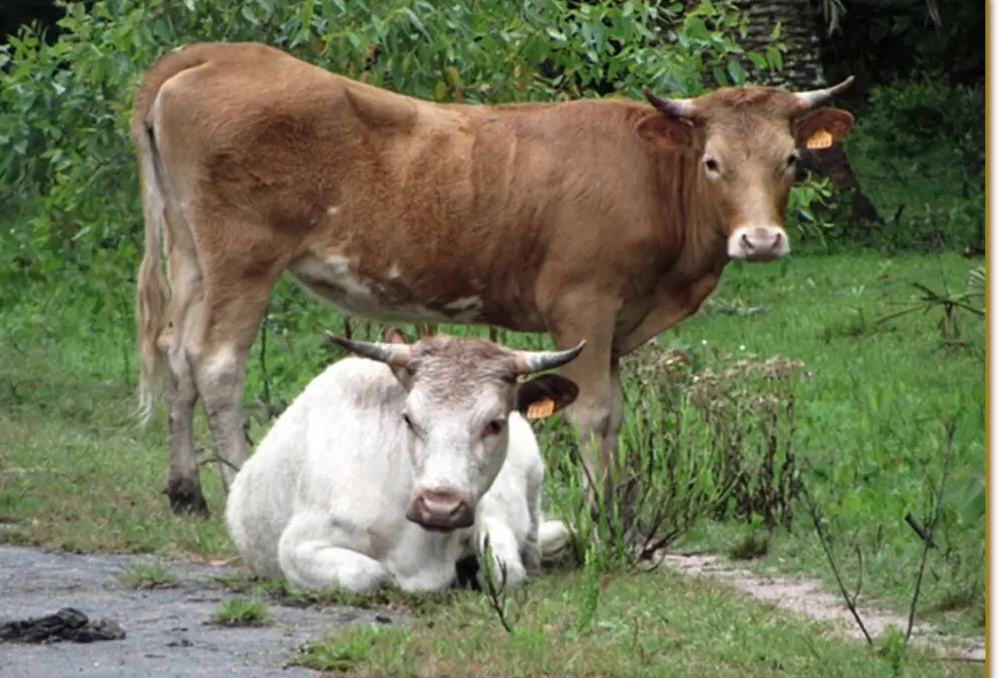
After seven years of woodland recovery, healthier grasslands, regenerating shrublands and improving soil health, we believe the time has come to bring back into the landscape one of the forces that helped shape it for thousands of years: large herbivores.
A Small Fence to Let the Woodland Keep Growing

Cattle can eat young shoots and prevent new trees from becoming established. By temporarily excluding livestock from this area, we are protecting the natural regeneration process and allowing young coronillas to reach a size at which they can continue growing without pressure. But what we are protecting is much more than a few trees.
We are safeguarding an ecological process: the regeneration of native woodland, the formation of new layers of vegetation and, with them, new refuges and sources of food for birds, insects and other animals. As the trees grow, the soil also changes. Humidity increases, organic matter accumulates and new conditions emerge for other species to establish themselves.
It is a small intervention, but it expresses a central idea at Las Nativas: sometimes helping nature simply means removing a pressure and giving it time to do its work. These trees have been growing for centuries. Our work today is to help the woodland continue doing so for many centuries to come.
Upcoming Workshops

The activities taking place this spring are about more than experiences. They are invitations to awaken, learn and develop new —and ancient— ways of perceiving, understanding and relating to ourselves, to one another and to the living world.
September 9–13 — Insight III Workshop
An experience of self-knowledge and personal development, organized by Insight, dedicated to creating transformative experiences that help people understand themselves better, reclaim their personal power and become more conscious of their choices.
Facilitators: Paula and Valeria Fernandez.
October 9–12 — Horses in the Wild Programme
Horses in the Wild is a three-day immersion at Las Nativas to discover what it means to nativize a horse. Through observation and coexistence with a herd living freely in a regenerating landscape, and guided by the EPICCA methodology, we explore new ways of understanding and relating to horses through presence, trust and respect for their own nature.
Facilitators: Daniela Alfaro and Alana Tassino.
October 10 — Therapeutic Yoga Day
A day dedicated to therapeutic yoga, holistic wellbeing, connection with the body and inner balance.
Facilitator: Viviana Curbelo.
October 16–18 — Rebirth in Nature Workshop
A transformative experience of renewal that integrates Family Constellations and Second Birth in deep contact with nature. A space to pause, look inward and open ourselves to new beginnings.
Facilitators: Maria José Lussich and Maria Giambruno.
November 21–22 — Fasting & Healthy Nutrition Workshop
A space to pause, rest and reconnect with the body through fasting, mindful eating and a deeper connection with nature.
Facilitators: Dr. Natalie Nabén and Dr. Maria José Lussich.
Las Nativas opens its doors to those seeking something more than an experience: to those looking for time to pause, reconnect.


Comments